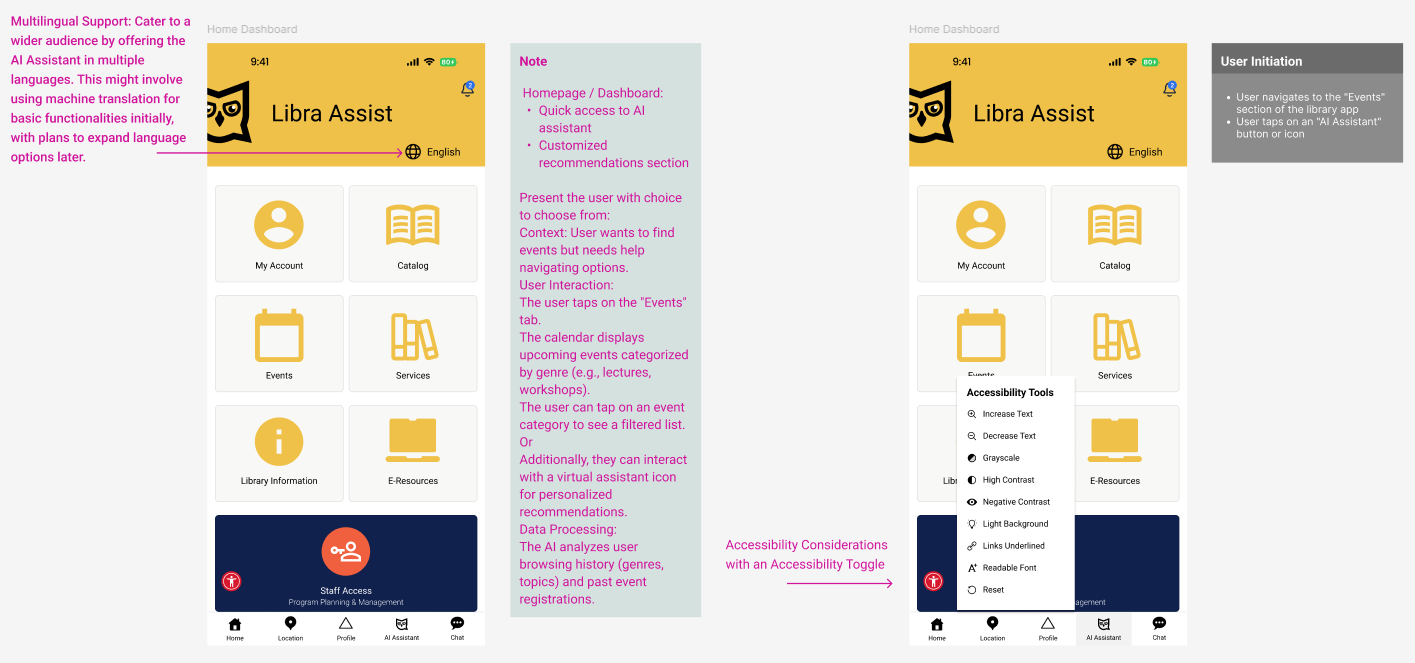
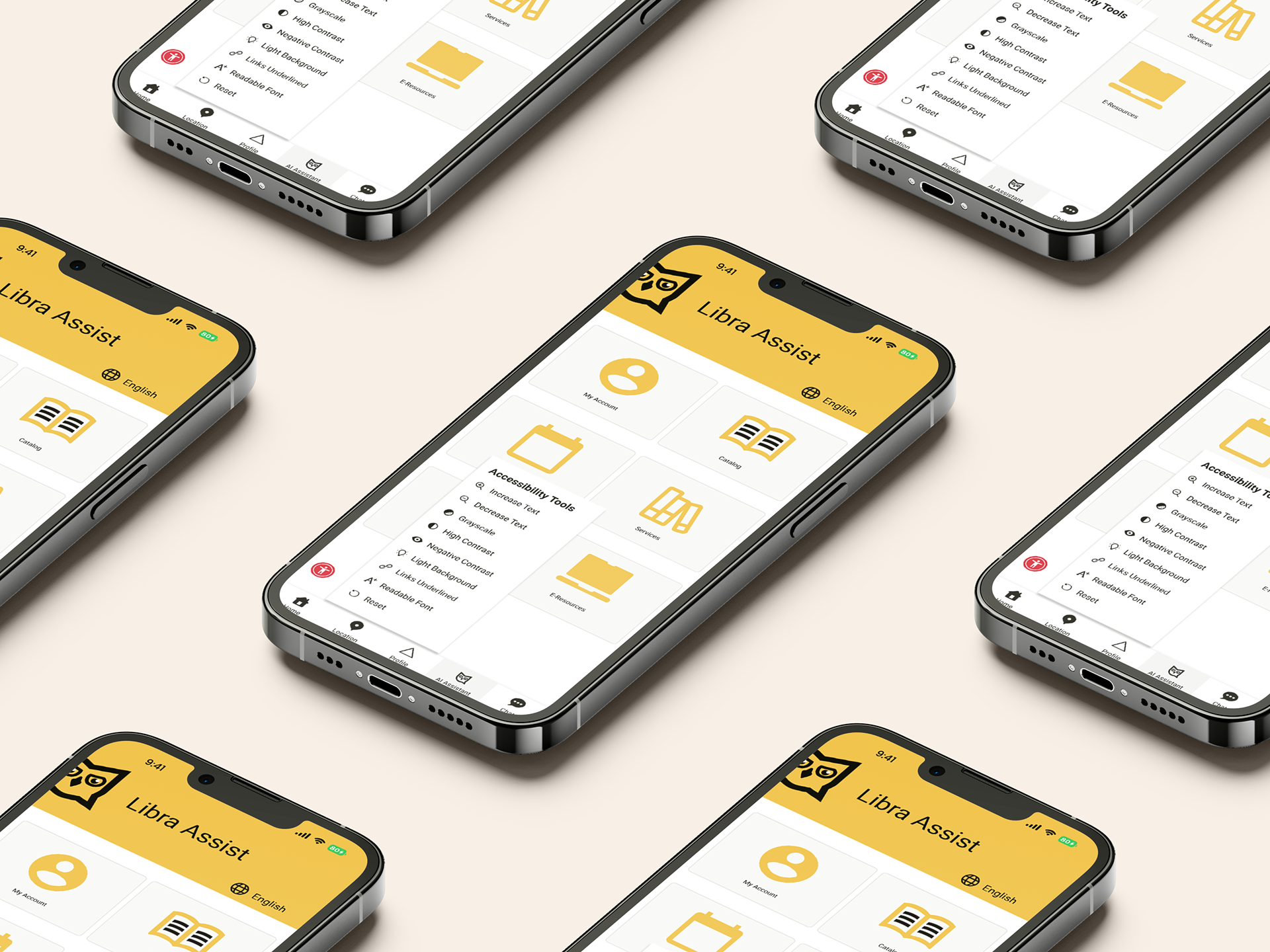
Libra Assist main dashboard showing the clean, accessible 6-tile navigation with golden branding and multilingual support

Libra Assist: Transforming Library Experience with Conversational AI
Role: UX/UI Designer & Product Strategist
Timeline: 3 months (concept to interactive prototype)
Team: Solo design project with developer consultation
Tools: Figma, User Research
Challenge: Traditional libraries are transactional and fragmented—users struggle to discover relevant books, find events that match their interests, and navigate disconnected services. Libraries need a unified, intelligent experience that feels personal and helpful.
Solution: AI Library Genie (Libra Assist) - A conversational AI assistant that acts like a knowledgeable librarian, remembering user preferences, connecting books to events, and providing personalized recommendations across all library services.
Comprehensive Solution Architecture
Multi-Stakeholder AI System
Rather than designing just a patron-facing app, I created an intelligent ecosystem that serves four distinct user types while maintaining unified AI intelligence across all touchpoints.
Patron Experience Layer
Target Users: May (Academic Parent), Alex (Engaged Retiree)
• 24/7 conversational AI assistant accessible via mobile, web, and voice
• Personalized recommendations based on reading history and stated interests
• Natural language interaction for complex research needs
• Seamless integration of physical and digital resources
Staff Empowerment Layer
Target Users: Maya (Programs Librarian), Front Desk Staff
• AI handles routine inquiries, freeing staff for complex assistance
• Real-time program planning and resource allocation support
• Automated community outreach and engagement tools
• Cross-departmental coordination and communication
Management Intelligence Layer
Target Users: Lisa (Collection Development), Department Heads
• Predictive analytics for collection development and budget optimization
• Real-time performance monitoring and trend analysis
• Automated diversity auditing and gap identification
• Data-driven program impact assessment
Executive Dashboard Layer
Target Users: Library Directors, Board Members, Stakeholders
• Strategic planning support with community demographic analysis
• ROI analysis and budget optimization recommendations
• Grant opportunity identification and impact reporting
• Crisis management and predictive risk assessment

Accessibility features panel demonstrating comprehensive inclusive design with text scaling, contrast options, and visual accommodations
Core AI Capabilities
1. Memory & Learning Engine
• Patron Memory: Reading history, preferences, learning goals, event attendance
• Staff Memory: Workflow patterns, frequently asked questions, resource usage
• Community Memory: Demographic shifts, seasonal trends, local events impact
• System Memory: Performance metrics, successful interventions, optimization opportunities
2. Cross-Service Intelligence
• Horizontal Integration: Links books → events → digital resources → community programs
• Vertical Integration: Connects patron needs → staff resources → management decisions → executive strategy
• Temporal Intelligence: Understands timing for recommendations, reminders, and proactive suggestions
• Contextual Awareness: Considers location, device, time of day, and current library context
Real-World Application Scenarios
Scenario 1: May's After-Hours Research Emergency
9:30 PM - Library Closed
May: "I need help finding sources for a paper on social media's impact on teen mental health due next week"
AI Response Process:
• Context Analysis: Recognizes May's academic level from previous interactions
• Resource Mapping: Scans available digital resources, cross-references with her research patterns
• Intelligent Curation: Selects 3 e-books, 2 peer-reviewed articles, 1 documentary
• Proactive Suggestions: Recommends upcoming "Researching in the Digital Age" workshop
• Continuous Support: Creates citation bibliography, sets follow-up reminders
Impact: May gets immediate access to relevant resources and discovers workshop opportunity she wouldn't have found otherwise.

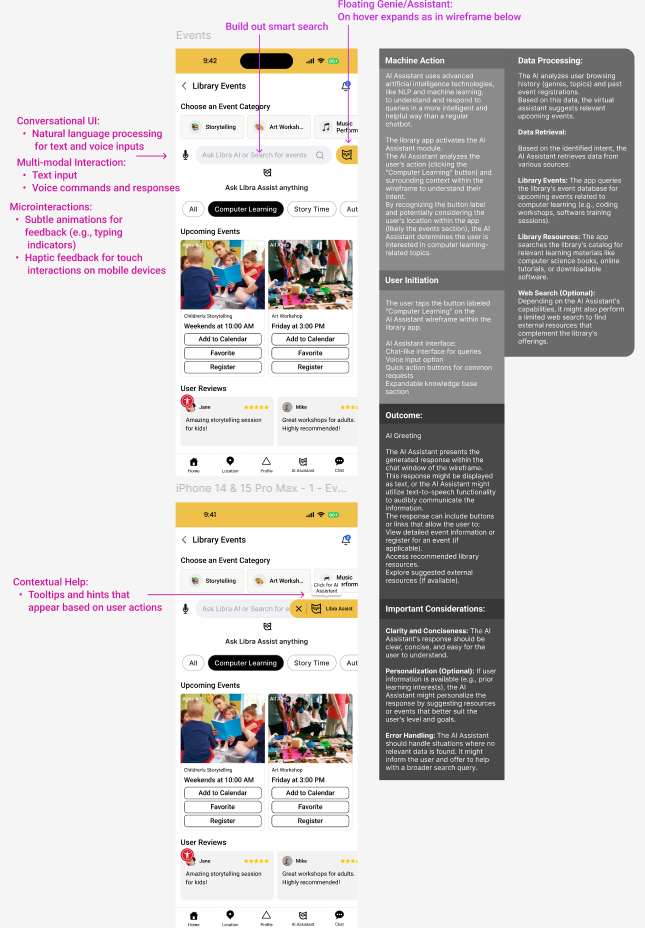
Event discovery interface with AI-powered search, category filters, and personalized recommendations based on user interests
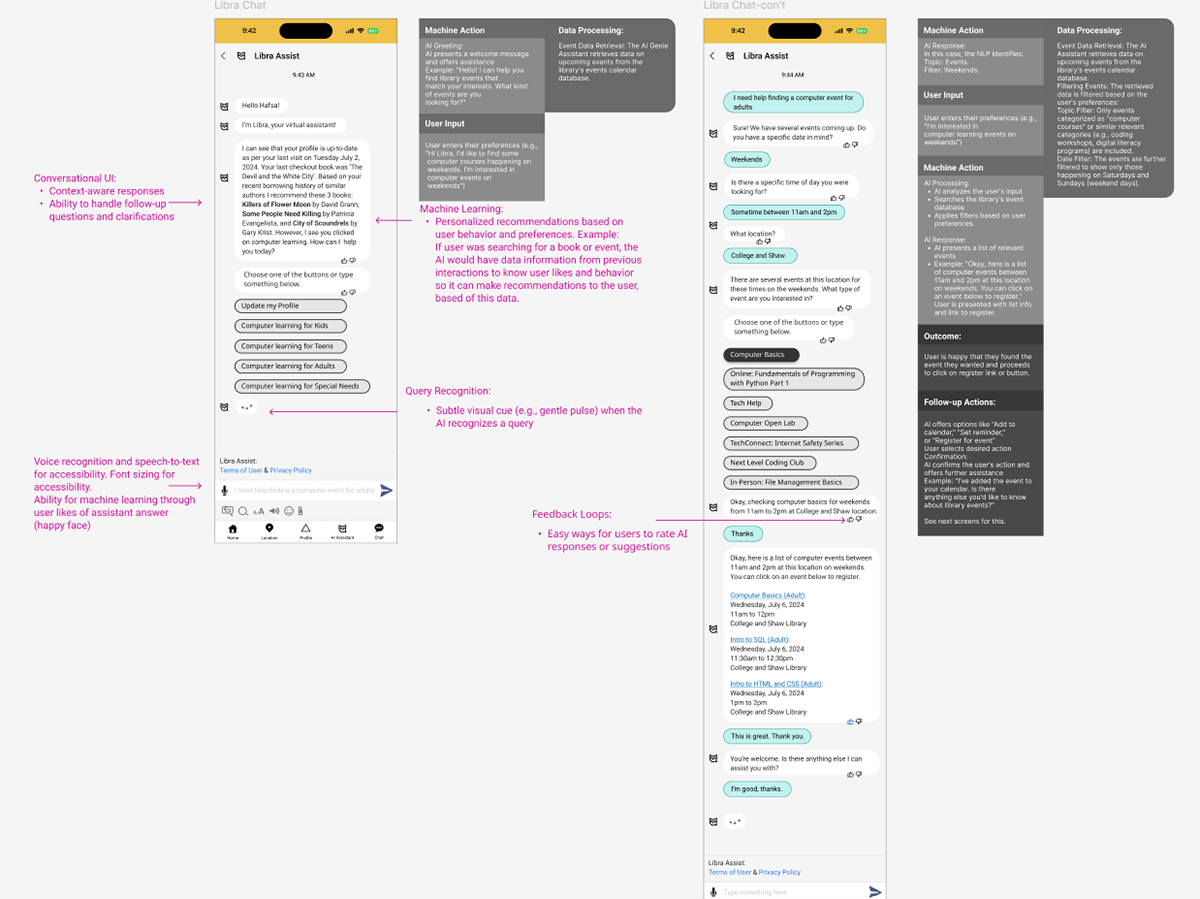
Conversational AI chat showing natural language interaction for finding computer events, with smart suggestion buttons and contextual responses
Scenario 2: Alex's Community Engagement Journey
Morning Voice Interaction via Smart Speaker
Alex: "Hey Library Assistant, what's new in local history?"
AI Response Process:
• Personalized Updates: References Alex's interest in post-war architecture
• Cross-Modal Transition: Sends tablet link for deeper exploration
• Community Connection: Suggests Historical Society volunteer opportunity
• Skill Integration: Proposes "Tech Buddies" intergenerational program
• Wellness Integration: Recommends "Historical Walks" combining interests with activity
Impact: Alex stays engaged with library, contributes community knowledge, and builds intergenerational connections.
Scenario 3: Maya's Program Development & Management
Planning "Digital Literacy for All" Initiative
Maya: "Can you help me plan a 'Digital Literacy for All' program?"
AI Support Process:
• Community Analysis: Reviews demographics and survey data to recommend focus areas
• Resource Assessment: Analyzes current equipment and suggests additional needs
• Targeted Outreach: Creates multilingual marketing materials and identifies community partners
• Real-Time Adjustment: Monitors attendance and automatically adjusts room allocations
• Impact Measurement: Compiles progress reports and community impact assessments
Impact: Program sees 50% higher attendance than expected, 40% average skill improvement, and 30% increase in library card registrations.

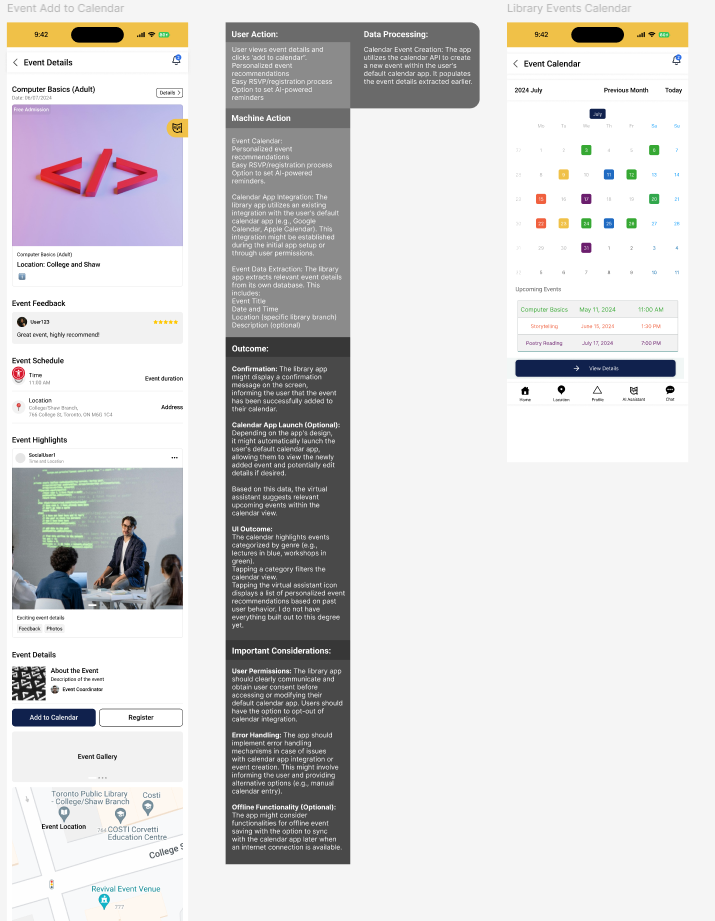
Event calendar integration with color-coded categories and seamless "Add to Calendar" functionality for unified scheduling
Scenario 4: Lisa's Strategic Collection Development
Data-Driven Acquisition Decision Making
Lisa: "What are our patrons' current reading trends?"
AI Analysis Process:
• Trend Identification: Identifies 40% increase in climate change/sustainability interest
• Gap Analysis: Recommends highly-rated titles not currently owned
• Budget Optimization: Suggests vendor comparisons and format allocation adjustments
• Predictive Planning: Forecasts demand based on local events (gardening festival)
• Diversity Auditing: Identifies underrepresentation and suggests targeted acquisitions
Impact: 12% cost savings on vendor switching, improved collection diversity, and proactive community need fulfillment.

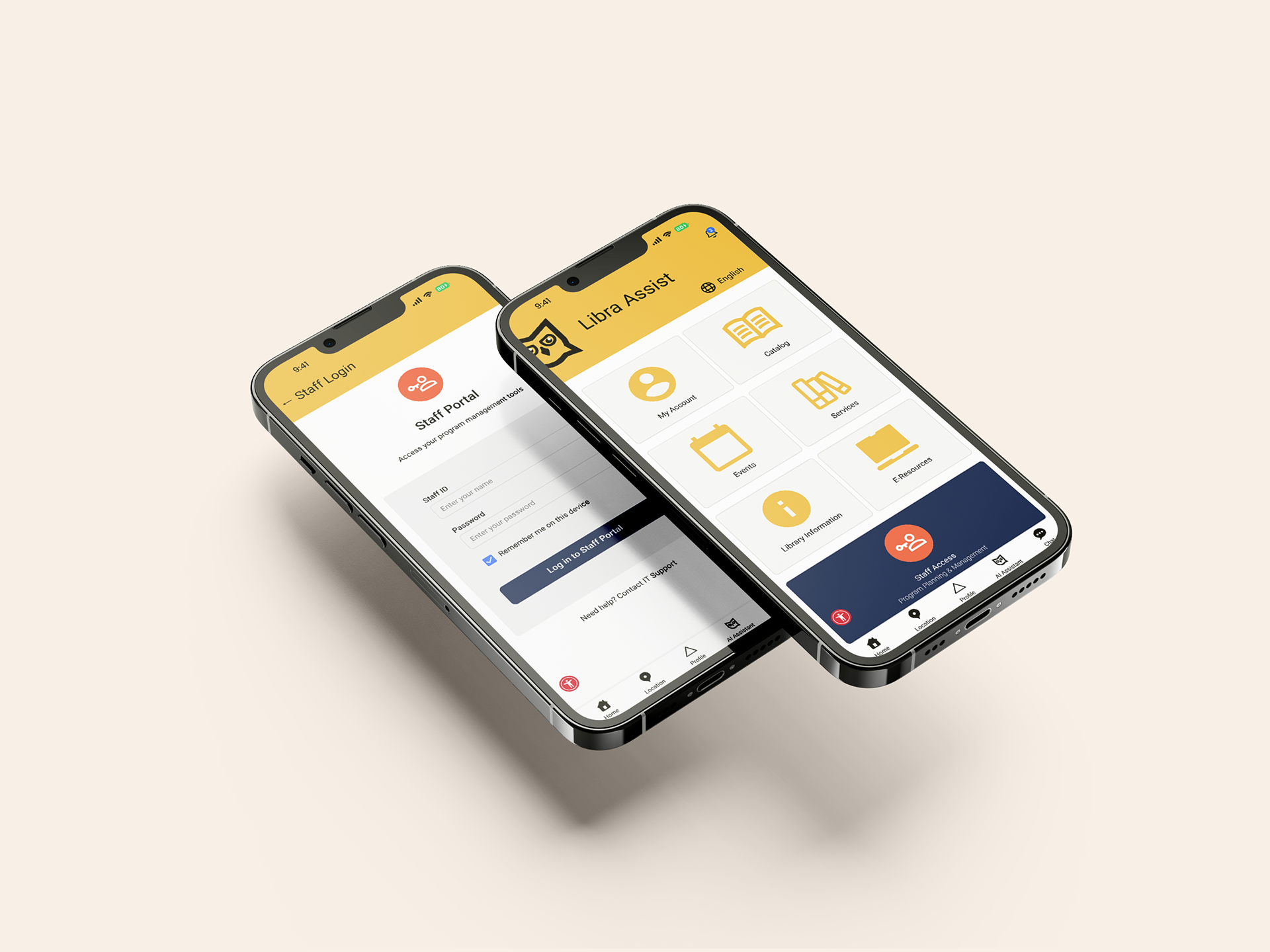
Staff login flow demonstrating secure authentication and AI role recognition for personalized workspace access
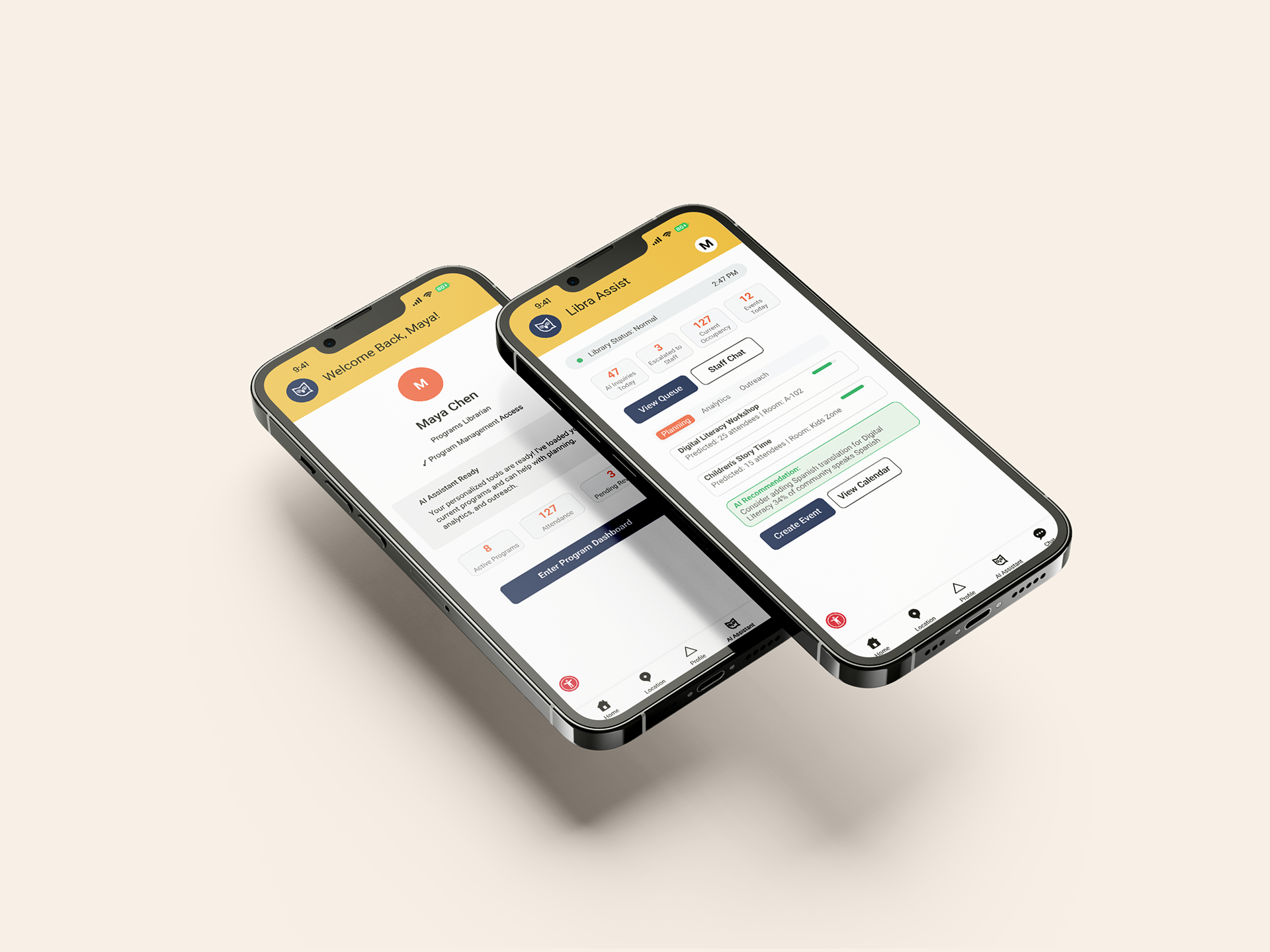
Staff dashboard comparison showing role-based customization - Maya's program management tools vs. enhanced patron interface
User Research & Personas
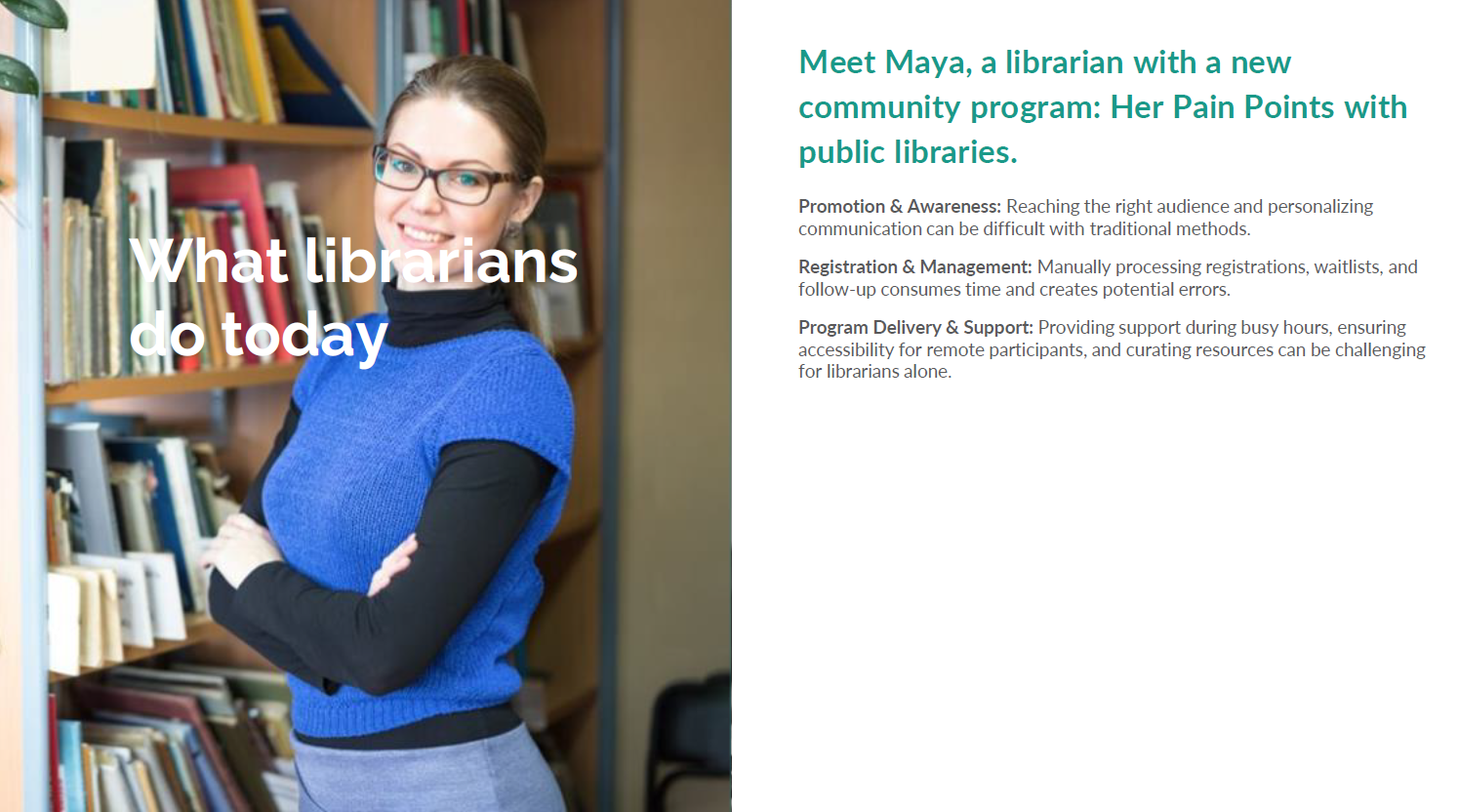
Research included 20+ user interviews, staff interviews, and competitive analysis to validate the multi-stakeholder approach.
Primary User Personas
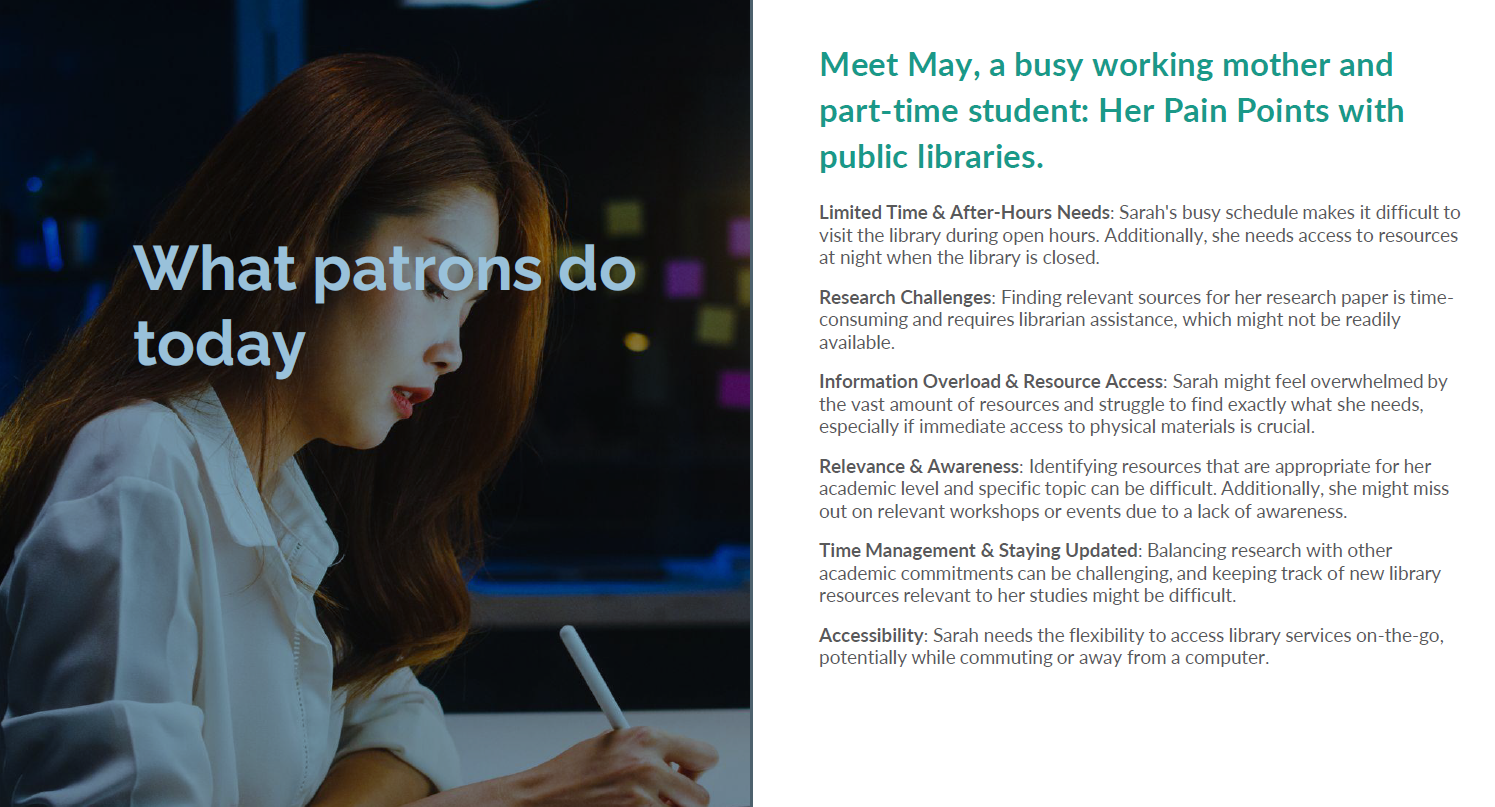
Persona 1: May - The Busy Academic Parent
Age: 34 | Role: Working mother, part-time graduate student | Tech Comfort: Medium
Needs & Pain Points:
   • Requires 24/7 access to research materials due to irregular schedule
   • Struggles to find relevant academic resources quickly
   • Wants personalized recommendations that understand her research level
   • Needs seamless integration between physical and digital resources
Key Quote: "I love the library but I feel like I'm only using 20% of what's available"
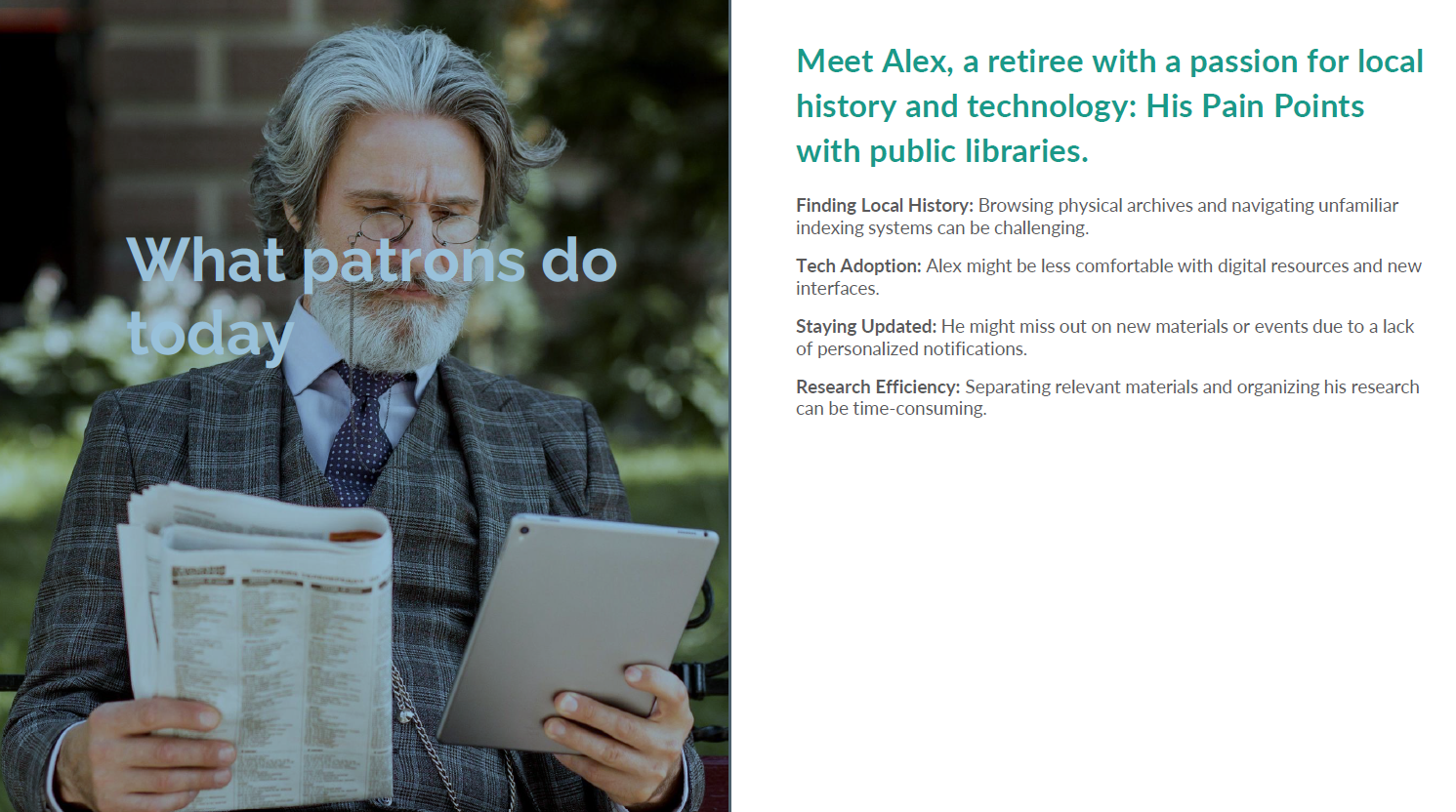
Persona 2: Alex - The Engaged Retiree
Age: 66 | Role: Retired teacher, local history enthusiast | Tech Comfort: Growing
Needs & Pain Points:
   • Wants to contribute knowledge while continuing to learn
   • Interested in community engagement and intergenerational connection
   • Needs accessible interfaces that adapt to changing abilities
   • Values both digital innovation and human connection
Key Quote: "I have so much knowledge to share, but I also want to keep learning new things"
Persona 3: Maya - The Progressive Librarian
Age: 29 | Role: Community programs coordinator | Tech Comfort: High
Needs & Pain Points:
   • Overwhelmed by routine questions, wants to focus on complex assistance
   • Needs data-driven insights for program development and resource allocation
   • Wants tools that enhance rather than replace human connection
   • Requires efficient ways to track program impact and community needs
Key Quote: "I wish I had more time for the meaningful work - helping people transform their lives through learning"
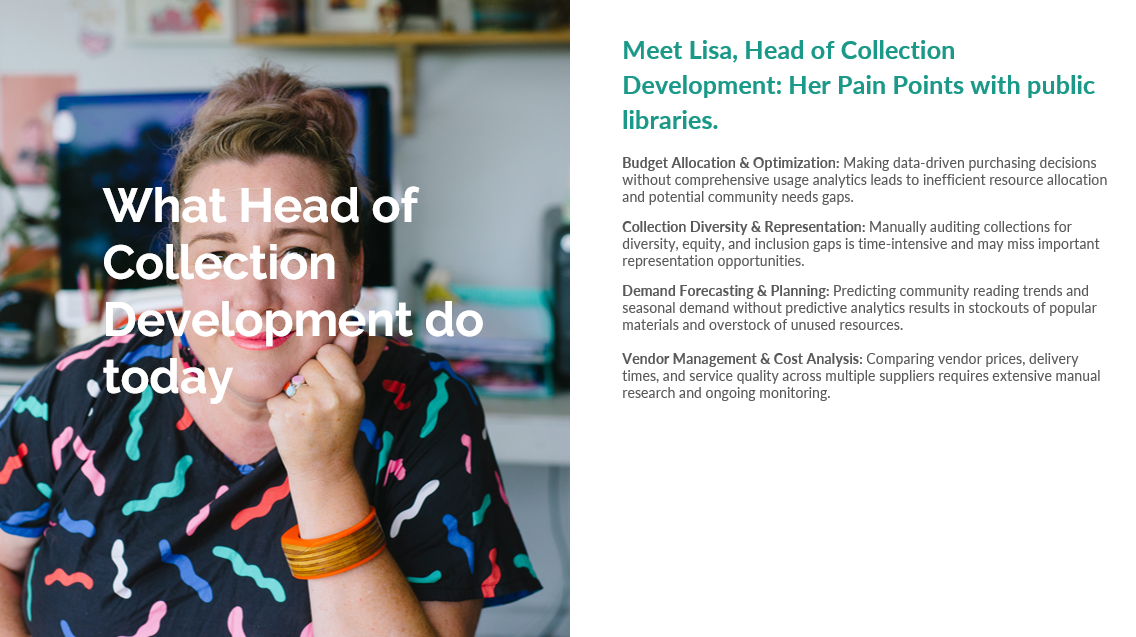
Persona 4: Lisa - The Strategic Executive
Age: 45 | Role: Head of Collection Development | Tech Comfort: High
Needs & Pain Points:
   • Requires real-time data for strategic decision-making
   • Needs predictive analytics for budget optimization and resource planning
   • Wants to demonstrate library value to stakeholders with concrete metrics
   • Struggles with complex data analysis across multiple systems
Key Quote: "Every decision I make affects our community's access to knowledge - I need data I can trust"
Research Insights
Behavioral Patterns Discovered
Cross-Persona User Needs
Personalization at Scale: All users want tailored experiences but understand libraries serve diverse communities
24/7 Intelligent Support: Extends beyond operating hours without losing the "librarian touch"
Seamless Integration: Digital and physical resources should feel unified, not fragmented
Transparent Intelligence: Users trust AI more when they understand the reasoning behind suggestions
78% of patrons stick to familiar sections/genres without AI guidance
65% attend events only when directly recommended by staff
89% would trust AI recommendations if reasoning was clearly explained
92% of staff time spent on routine queries that AI could handle
34% budget inefficiency due to reactive rather than predictive collection development
Current System Pain Points
"I spend 60% of my time answering the same basic questions over and over" - Reference Librarian
"We're buying books based on gut feeling rather than data about what our community actually needs" - Collection Manager
"Our users don't know about 80% of our services and resources" - Branch Manager
Design Process
Key Design Decisions
Core Design Principles
Conversational First - Natural language over complex navigation
Memory-Driven - AI remembers every interaction and learns preferences
Proactively Helpful - Anticipates needs rather than just responding
Transparently Intelligent - Always explains reasoning behind suggestions
Decision 1: Conversational UI as Primary Interface
Problem: Traditional apps require users to know exactly what they want
Solution: Natural language interface where users describe their interests
Rationale: Research showed users prefer describing needs rather than navigating complex menus
Decision 2: Memory-Driven Personalization
Problem: Users must re-enter preferences every session
Solution: AI maintains comprehensive memory of reading history and goals
Example: "Since you loved 'Until August', you'll enjoy this García Márquez classic"
Decision 3: Cross-Service Intelligence
Problem: Books, events, and resources feel disconnected
Solution: AI connects everything into unified learning paths
Example: Programming book → SQL workshop → related community resources
Visual Design Solutions
Design System
Golden Brand - Warm, knowledge-focused
Conversational UI - Clear AI/user distinction with chat bubbles
Progressive Disclosure - Complex features revealed gradually
Accessibility First - High contrast, large targets, screen reader optimized
Key Interface Innovations
Unified Navigation
AI Assistant always accessible, making it feel like a persistent companion
Contextual Integration
AI suggestions integrated into every screen rather than hidden in separate chat
Memory Visualization
Users can see what AI remembers in discrete "Memory Active" panel
Transparent Reasoning
AI explains every recommendation: "Based on your interest in magical realism..."

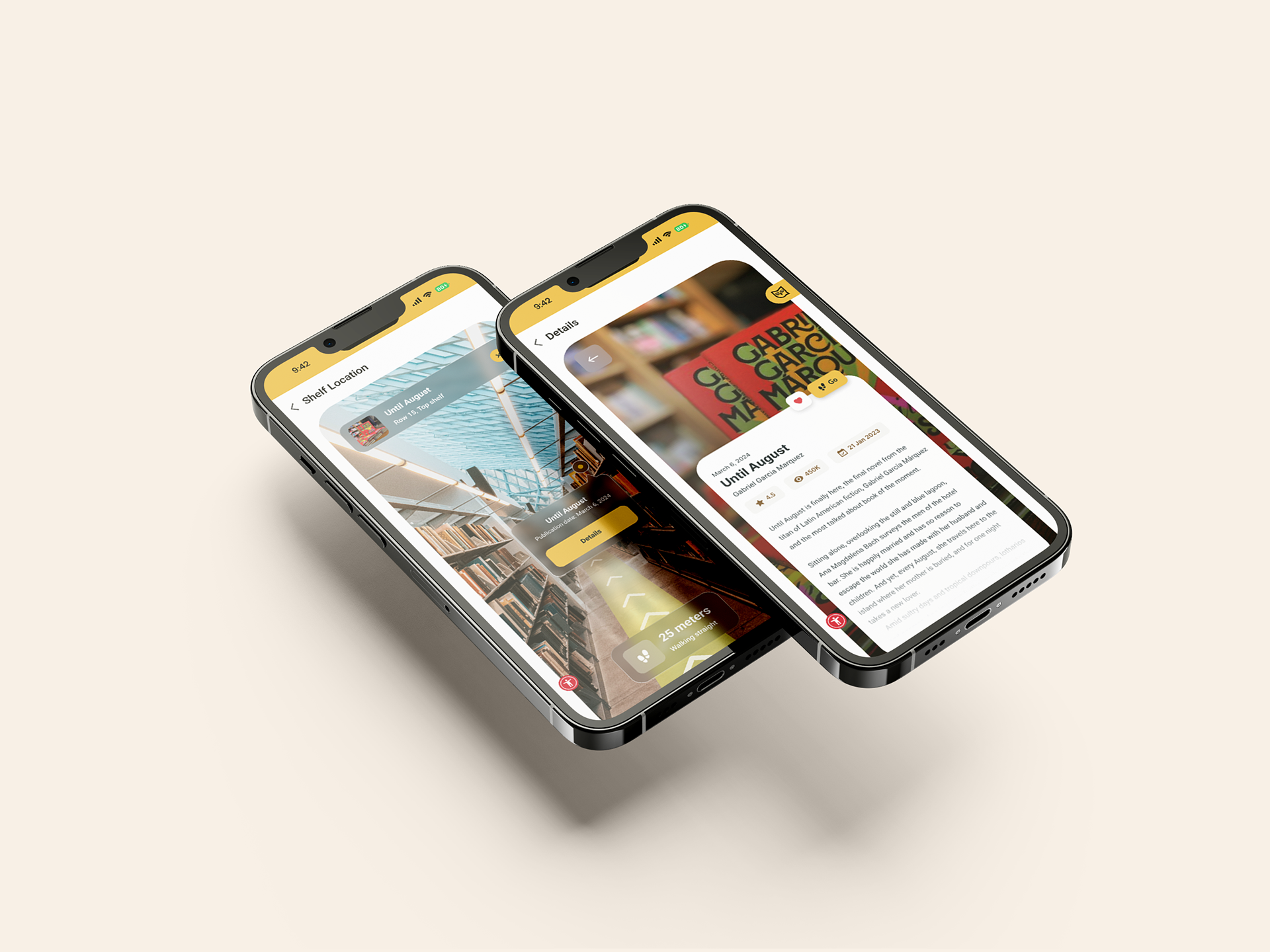
Physical-digital integration: AR-style shelf location feature connecting users to exact book placement within the library
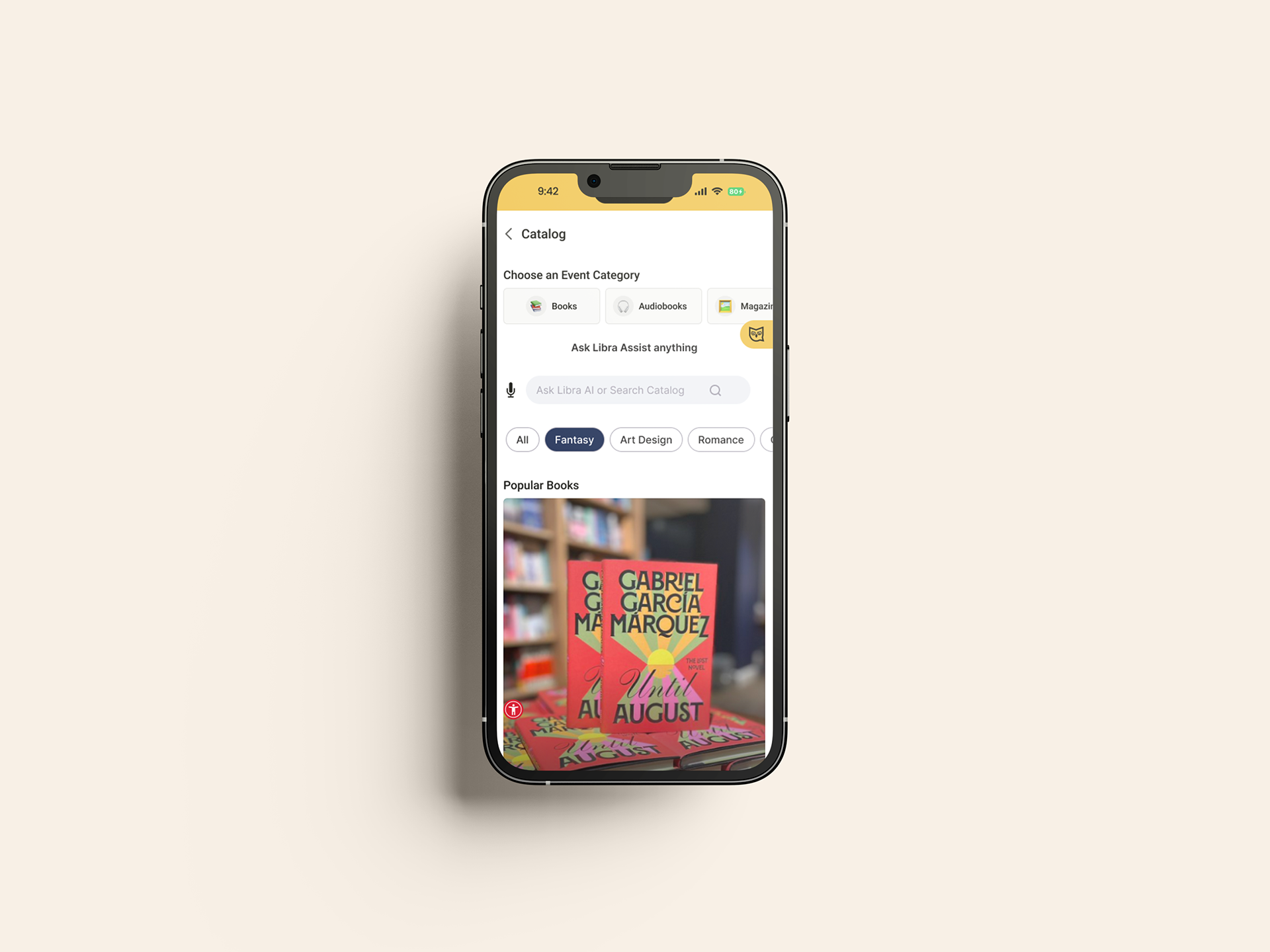
Catalog browsing with AI assistant integration, showing personalized book recommendations and cross-service intelligence
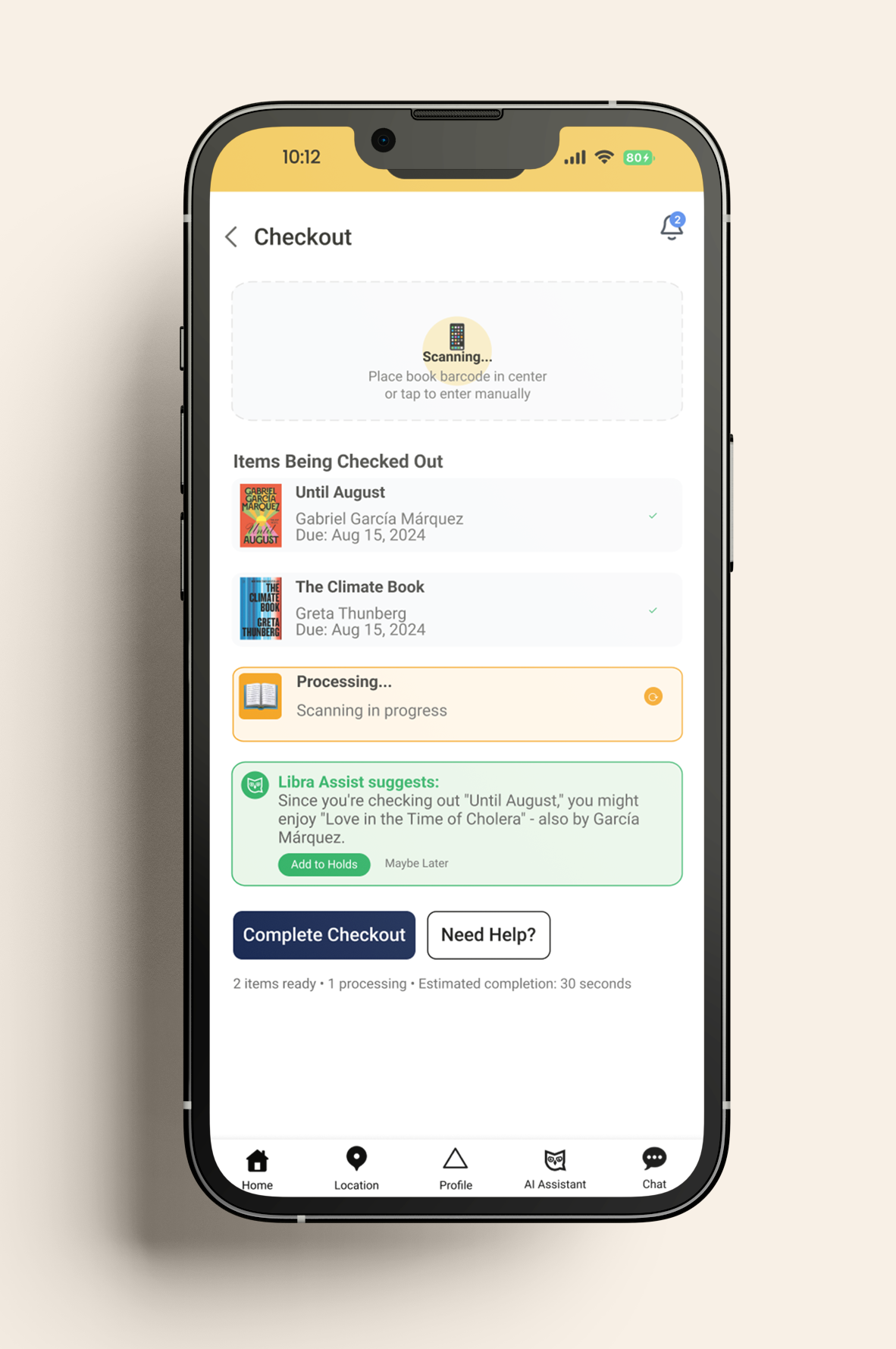
Physical Library - Actual Checkout
When: User is physically in the library with books in hand
How It Works:
1 User scans book barcode with phone camera
2 AI recognizes book and user's library card
3 Book is immediately checked out to user
4 AI suggests related books and sets due date
Features:
Instant checkout with barcode scan
Automatic due date calculation
Real-time availability confirmation
Smart recommendations based on selection
Integration with library security system
Receipt and reminder notifications
Physical Checkout AI Features:
• Smart Recognition: Instantly identifies books and calculates optimal loan periods
• Personalized Suggestions: Recommends related titles based on current selection
• Conflict Detection: Alerts if book is already checked out or on hold
• Learning Patterns: Remembers user preferences for future recommendations

Physical checkout flow: Real-time barcode scanning with AI suggestions for related books and automatic due date calculation
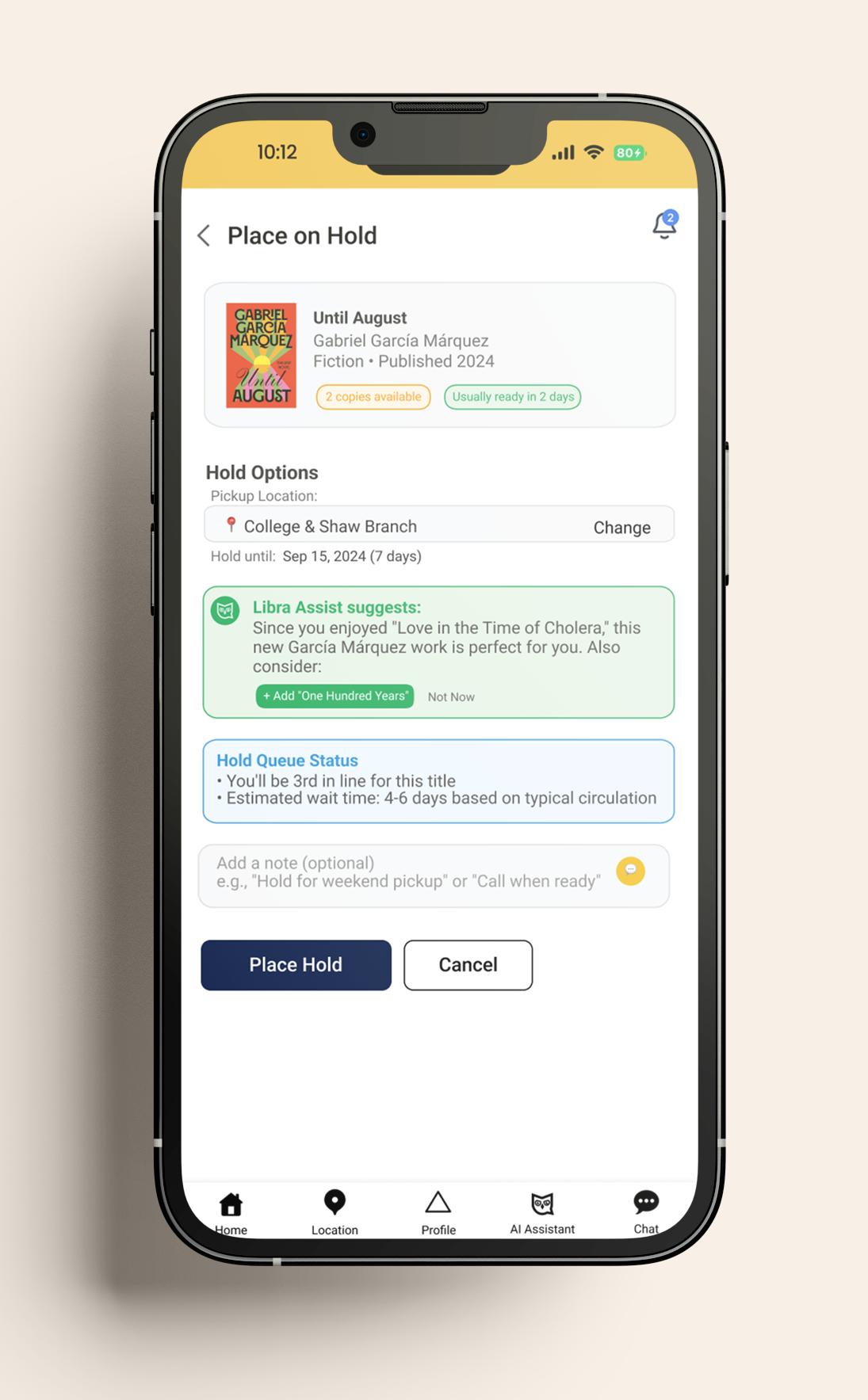
Place hold interface showing queue position, wait time estimation, and contextual notes for pickup preferences

Remote Browsing - Place Hold
When: User is browsing catalog from home or elsewhere
How It Works:
1 User browses catalog and finds desired book
2 Taps "Place Hold" button on book details
3 Book is reserved and added to hold queue
4 User gets notification when ready for pickup
Features:
Reserve books for later pickup
Queue position and estimated wait time
Multiple pickup location options
Hold expiration date management
Notification when item is available
Hold Placement AI Features:
• Wait Time Prediction: Estimates how long until book becomes available
• Alternative Suggestions: Offers similar available books to reduce wait
• Optimal Timing: Suggests best times to place holds based on circulation patterns
• Smart Notifications: Personalized alerts when items are ready
Prototype & Validation
Core User Flows Designed
1. Intelligent Checkout
User scans book → AI recognizes connection to reading history → Suggests optimal loan period → Offers related workshops
2. Event Discovery
User asks about computer classes → AI finds weekend options → Suggests preparation materials → Connects to learning path
3. Cross-Service Recommendations
After attending workshop → AI suggests related books → Offers advanced classes → Connects with similar learners
Key Learnings
What Worked in Design Process
• Transparent AI reasoning builds trust through explanation of recommendations
• Multi-stakeholder approach addresses needs across entire library ecosystem
• Memory-driven personalization creates ongoing relationships vs. one-time transactions
• Cross-service intelligence connects previously siloed library functions

Research Insights Applied
78% resource underutilization → Conversational discovery eliminates navigation barriers
60% repetitive staff queries → AI automation frees librarians for complex assistance
Fragmented user experience → Unified conversational interface connects all services
No personalization → Memory system creates tailored recommendations and learning paths
Challenges Addressed
Staff concerns → Positioned AI as augmentation tool, not replacement threat
Privacy considerations → Designed granular controls and transparent data policies
Digital accessibility → Created multiple interaction modes and progressive complexity
Local relevance → Planned integration of community-specific data and cultural context

Strategic Impact
Innovation: First comprehensive conversational AI for public library systems
Market Opportunity: Libraries actively seeking AI implementation solutions (TPL recently received $2.7M for AI education, showing institutional commitment to AI initiatives)
Scalability: Framework applicable to 9,000+ public libraries across North America
Portfolio Highlights
This Project Demonstrates:
Systems thinking across complex multi-stakeholder environments
Conversational AI design with transparent, trustworthy interactions
Service design that transforms institutional operations
Business strategy with realistic funding and implementation plans
Social impact focus on equity and community benefit
This case study showcases expertise in emerging AI technologies, public service design, and creating solutions that balance innovation with accessibility and trust.

If you are interested in this project and would like to see the prototype or user flow, please reach out.
Want to work with me?

You may also like

Back to Top